Machine Design: 3-Axis Filament Winder
The Goal
To democratize custom carbon fiber tubing for the HB_DFab Capstone, I needed a way to produce consistent, high-performance laminates without the $50,000 price tag of industrial winders. My solution was to engineer a 3-Axis Filament Winder from the ground up.
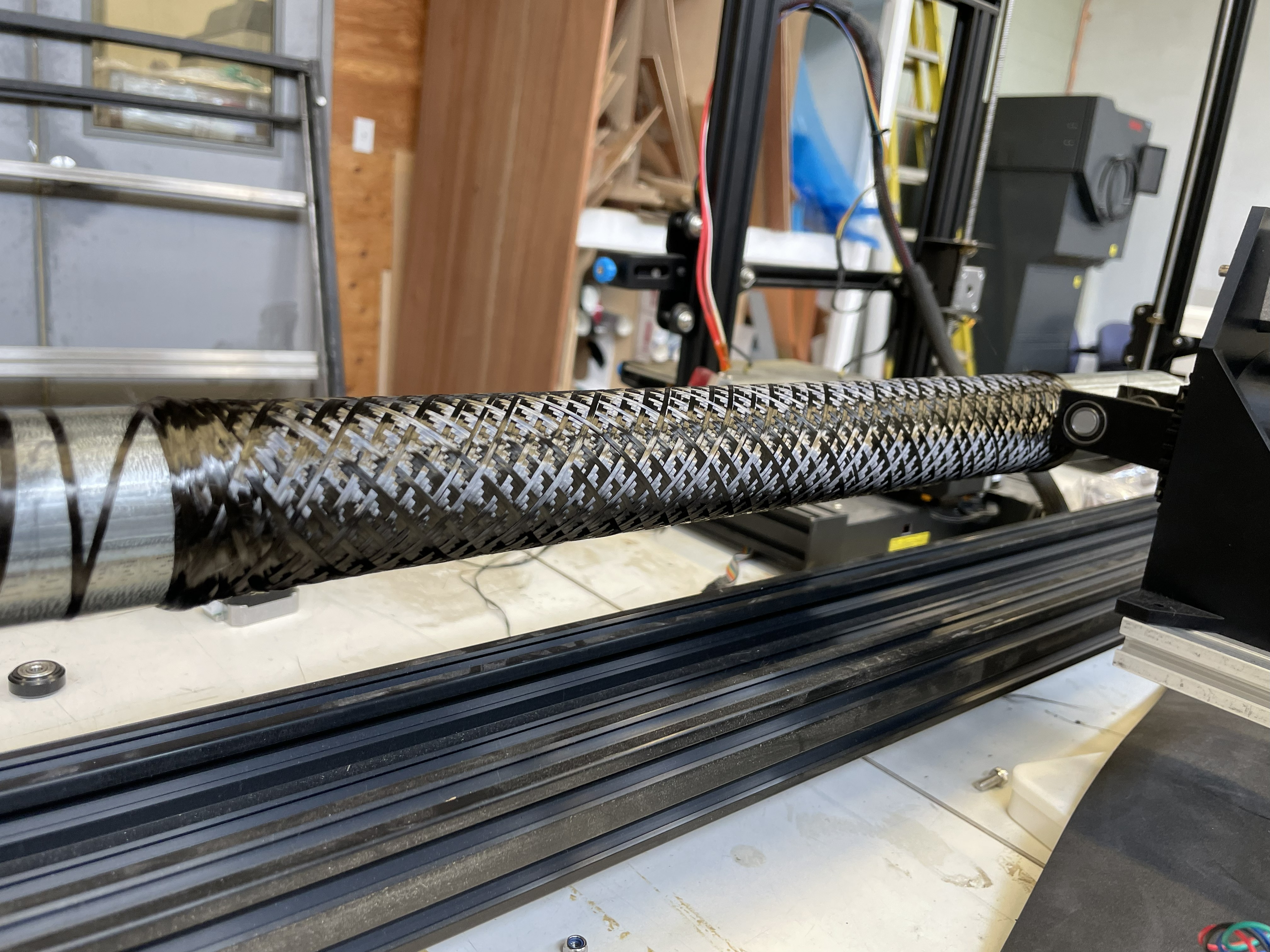 The machine in operation, laying a ±45° helical pattern on a mandrel.
1. Mechanical Design: The “Active Eye”
Most DIY winders use a static delivery ring. This causes the fiber to twist and lay unevenly on the mandrel when winding high angles. I engineered a 3rd Axis (Active Delivery Eye) that rotates in sync with the carriage direction.
*Close-up of the Z-Axis rotating the eyelet to keep the carbon tow flat against the mandrel.*Key Features:
- Motion System: Custom 3-Axis (Rotational Spindle, Linear Carriage, Rotating Delivery Eye).
- The “Spine”: A rigid steel core supports the flexible silicone mandrel, preventing whip at high RPM.
2. The “Brain”: Klipper & Electronics
Most DIY winders use Arduino (Marlin). I chose Klipper because of its ability to handle high-speed kinematics.
*The full motion system running a dry-wind test pattern.*3. The Logic: Solving “Pattern Drift”
The hardest part of this build was the math. Initial tests showed “Pattern Drift,” where the fibers would leave gaps after several rotations. I wrote a custom G-Code Generator that calculates the “Integer + Fraction” ratio to lock the pattern.
You can view the full G-Code Generator tool and try the math yourself in the Project Docs.